Korean Eyelash Extension Singapore: What Makes the Technique Different
Korean-style eyelash extensions use ultra-thin 0.03–0.07mm fibres, hand-made fans, and KC-certified materials. An award-winning Singapore lash artist explains what's actually different and what to ask for.
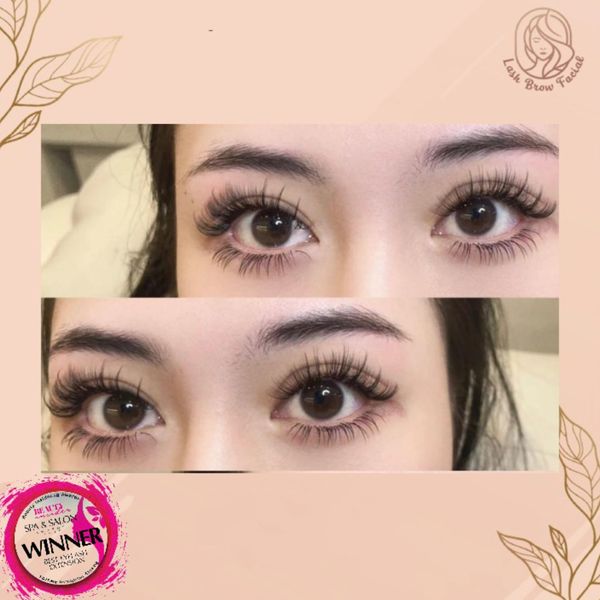
“Korean-style” is the most-used and least-defined term in the Singapore lash industry. Almost every salon advertises it. Almost none explain what they actually mean.
The truth: Korean eyelash extensions are a real, measurably distinct technique — not just a marketing label. Below is what actually makes it different, what to ask for, and how to verify your studio is doing the real thing.
The three things that actually define Korean-style lashes
1. Ultra-thin individual fibres (0.03–0.07mm)
Traditional American or Russian volume lash fibres are 0.10–0.15mm. Korean technique pioneered ultra-thin synthetic fibres in the 0.03–0.07mm range. The thinner each fibre, the more fibres you can fan onto one natural lash without stressing the follicle.
Mathematically: a 0.05mm fibre is half the weight of a 0.10mm fibre. So you can fan twice as many onto one natural lash for the same total weight. This is how Korean studios deliver dramatic volume that still feels weightless.
What to ask: “What fibre diameter do you use?” If the answer is anything thicker than 0.07mm, it's not actually Korean-style.
2. Hand-made fans (not pre-fanned)
Korean technique calls for the lash artist to hand-make each fan during the appointment — picking up 5 to 9 individual ultra-thin fibres at the application surface, fanning them, dipping in adhesive, and bonding to a single natural lash. This takes 10–15 seconds per fan.
Pre-fanned (or “machine-fanned”) extensions are factory-assembled clusters that the artist picks up and bonds directly. Faster. Cheaper. Heavier. Not Korean technique.
What to ask: “Are these hand-made fans?” The artist should be able to show you the fanning motion on a practice strip in 5 seconds.
3. KC-certified materials
KC (Korea Certification) is a Korean government safety standard for cosmetic and personal-care materials. KC-rated lash fibres and adhesives have undergone toxicity, fume and allergen testing. The mark is on every KC-certified box.
Many SG salons advertise “Korean lashes” while actually using Chinese-manufactured fibres labelled with Korean branding. The difference shows up in two places: fume sensitivity (KC-rated adhesives are low-fume by spec) and retention rate (KC-rated fibres have consistent taper).
What to ask: “Can I see the KC certification on the lash box?” If the studio can't show it, it's not KC-certified.
Why Korean technique suits Asian eyes specifically
Korean lash technique evolved alongside Korean face-mapping methodology, which is built around three characteristics common in East Asian and Southeast Asian eye shapes:
- Finer, sparser natural lash density compared to European eyes — needs lighter fibres
- Lower brow ridge / less lid space — needs precise curl calibration to avoid pushing into the lid
- Monolid and inner-double-eyelid variants — needs careful inner-corner mapping to avoid hooding
At Serenity Beaute we follow Korean technique on every full set across our eyelash extension Singapore menu. If you have monolid or hooded eyes, read our dedicated guide on lash mapping for different Asian eye shapes.
Korean vs Russian vs American volume — quick comparison
| Technique | Fibre size | Fans per lash | Vibe |
|---|---|---|---|
| Korean | 0.03–0.07mm | 5–7 (Volume) / 7–9 (Mega) | Soft, weightless, natural-fluffy |
| Russian | 0.05–0.10mm | 2–6 | Defined, dramatic, denser |
| American Classic | 0.10–0.15mm | 1 (no fan) | Bold, visible, mascara-look |
What Korean-style sets look like at Serenity Beaute
All eleven of our curated lash styles are Korean-technique by default. The flagship Volume styles — Volume Fluffy and Volume Glorious — are the most distinctly Korean: 5–7D hand-made fans of 0.05mm fibres applied with 0.5-second-cure adhesive.
Our Designer tier — Manga and Camellia — uses 7–9D fans and remains weightless because the fibres stay at 0.05mm. This is the defining trick of Korean technique: you double the fibre count without doubling the weight.
How to verify your studio is doing the real thing
Five checks to do before your first appointment:
- Ask the fibre diameter. If above 0.07mm — not Korean.
- Ask to see the KC certification on the materials box.
- Watch the artist hand-fan one cluster on a practice strip. Real Korean technique looks like fanning a tiny deck of cards.
- Ask the cure time of the adhesive. Korean adhesives cure in 0.5–1 second; bargain adhesives take 2–3.
- Ask how long a full set takes. Real Korean technique is 120+ minutes for Volume, 150+ for Designer. If the artist promises 90 minutes for Volume, they're using pre-fanned clusters.
Book a trial
First-trial pricing for Korean-style sets at Serenity Beaute starts at $78 (Natural Lash by Lash, KC-certified fibres, hand-placed) and runs to $148 for Designer (7-9D hand-made fans). Book a consultation or WhatsApp us with a photo of your eyes for a no-obligation style recommendation.